A handstand video contains more information than “held” or “fell.”
It can show how you entered, where your body organized itself, what happened when balance moved, and whether the current drill matches the actual problem.
Manoj uses submitted photographs and videos to give precise feedback. Where useful, he can draw reference lines over an image, identify the relevant muscle groups, and explain both the correction and its purpose.
The setup before your feet leave the floor
The attempt begins before the kick-up.
A coach may look at:
- Hand placement and spacing.
- The distance from the wall.
- The starting leg and body position.
- Whether the shoulders are prepared to accept load.
- How the student intends to come down.
A rushed or inconsistent setup can make every later part of the attempt harder to interpret.
The entry
More force is not always better.
The video can reveal whether the student:
- Under-kicks and never reaches the balance point.
- Over-kicks and depends on the wall or an emergency exit.
- Changes the entry on every attempt.
- Arrives with bent arms or collapsing shoulders.
- Reaches the position with enough control to begin balancing.
Entry consistency matters because it gives the student repeated access to the same learning opportunity.
Hands, elbows, and shoulders
The hands are the base of support. Small changes there can affect the entire shape.
A coach may observe how the fingers interact with the floor, whether the elbows remain organized, and whether the shoulders actively support the position rather than sinking under it.
These details are not judged in isolation. They are considered alongside the student's strength, mobility, comfort and current progression.
Ribcage, pelvis, and the visible line
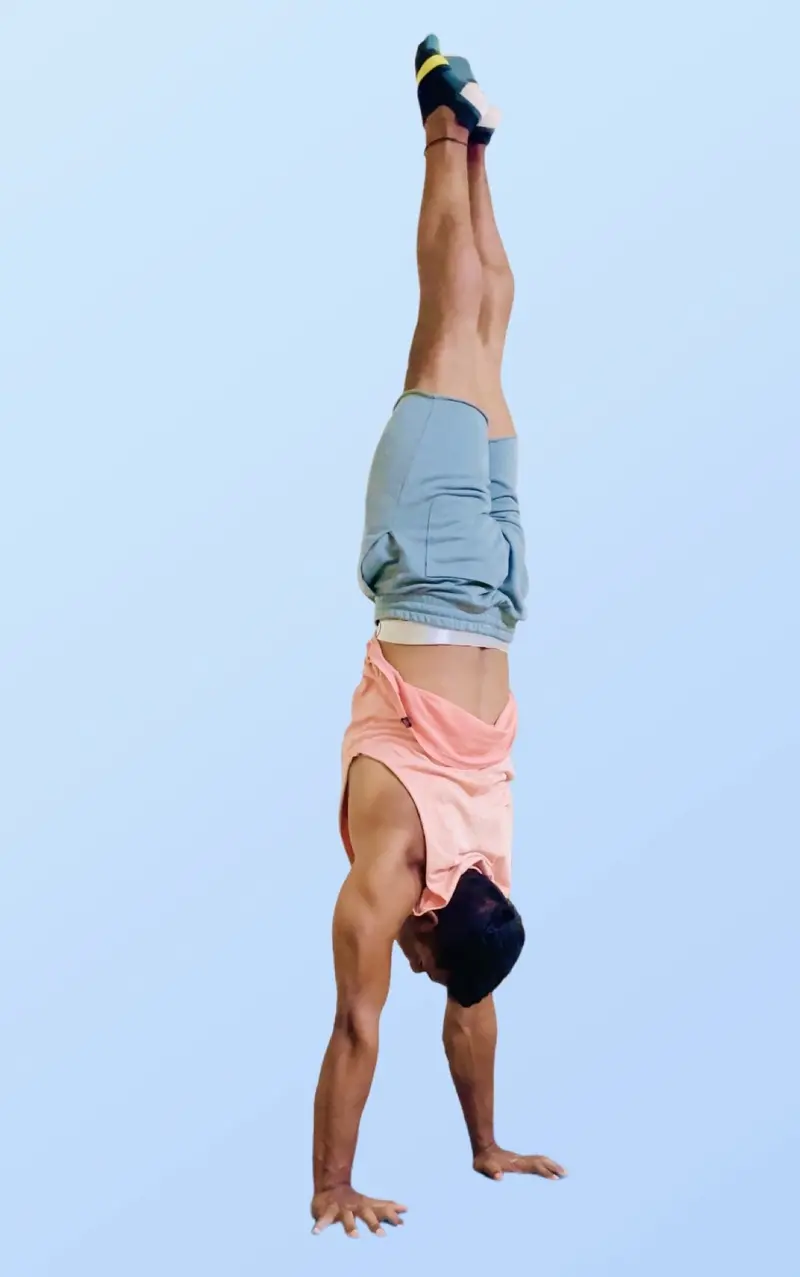
Many students focus only on whether their legs are overhead. A coach looks at how the sections of the body relate to one another.
Reference lines can make it easier to see:
- Whether the shoulders and hips are stacking.
- Whether the ribcage is flaring away from the intended shape.
- Whether the pelvis is organized or drifting.
- Whether a back arch is a deliberate shape or an uncontrolled compensation.
- Whether the legs are helping create one clear position.
Not every handstand must be a straight handstand. Tuck, straddle, split and other shapes have different intentions. The question is whether the shape is controlled.
What happens when balance changes
The most informative moment may be the instant before the student comes down.
Does the body make a small correction through the hands? Do the shoulders move? Does the student immediately bend, twist or panic? Is there a safe, familiar exit?
Balance is not the absence of movement. It is the ability to detect and respond to change.
Why muscle explanation helps
A cue such as “push taller” becomes more useful when the student understands where the action should come from.
Manoj's feedback can identify the relevant muscle or muscle group and connect it to the visible position. The student gains a task to feel, not only a line to imitate.
This is especially valuable online, where the goal is to make coaching information clear enough to use in the next attempt.
How to record a useful handstand video
Unless your coach requests something different:
- Place the camera where the entire body, hands and floor remain visible.
- Use a stable angle rather than following the athlete with the phone.
- Include the setup, entry, hold, and exit.
- Avoid slow motion as the only version; real-time speed shows timing.
- Record several normal attempts rather than only the best one.
- Use adequate light and avoid clothing that hides the body line.
- Tell the coach what you felt and what you were trying to do.
One honest set of attempts is usually more useful than a highlight reel.
Feedback should lead to one clear next step
A detailed analysis does not mean the student needs ten corrections at once.
The coach's job is to identify the correction that matters now, choose work that supports it, and revisit the video after practice.
To request an assessment, send Manoj a clear video along with your current goal and training history on WhatsApp.