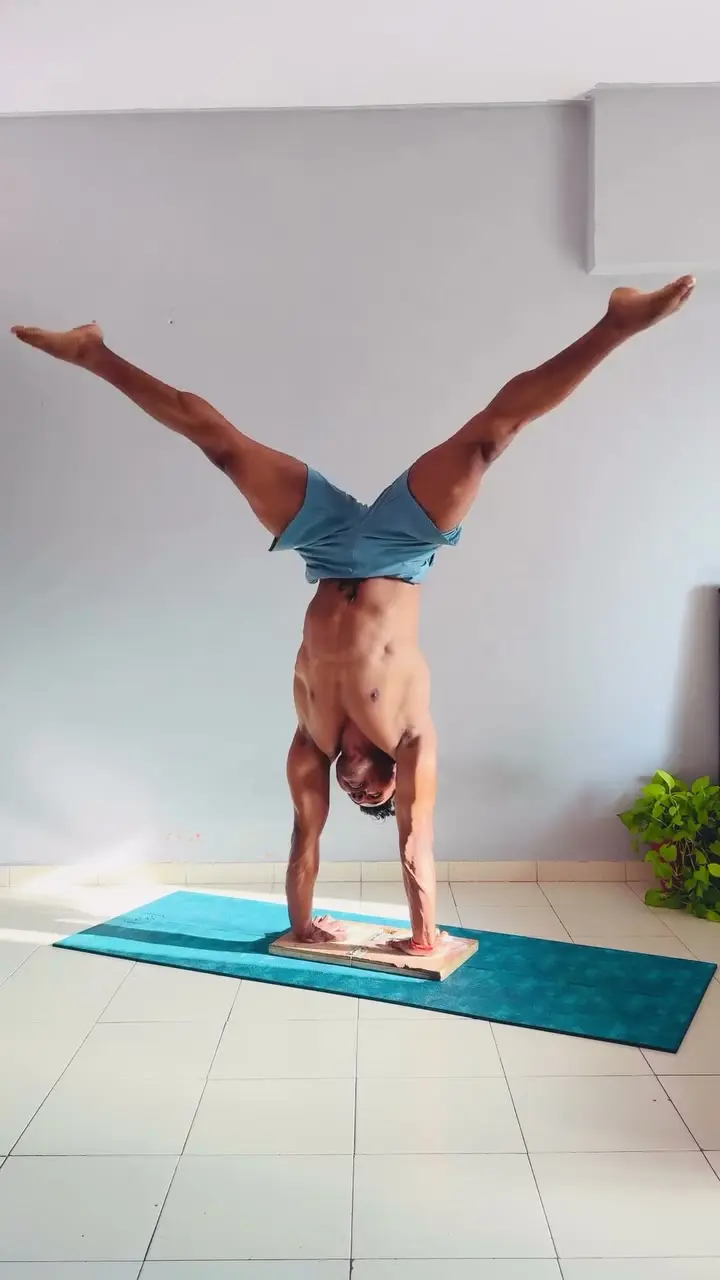
A handstand looks like balance. Underneath that balance is a physical structure.
Manoj regularly describes his work as skills and strength training. His profile does not isolate the handstand from everything around it. Alongside handstand practice, he shows handstand push-ups, planche work, human flags, muscle-ups, weight training, and gymnastics or calisthenics skills.
The point is not that every handstand student needs to perform all of those movements. Skill becomes more usable when the body has the capacity to support it, and the correct foundation is different for each person.
Start with the person, not the program
Manoj first listens to what a student wants. Then he assesses where that person is actually placed.
Those are different questions. Two people may both say, “I want a freestanding handstand,” while arriving with different strength, joint capacity, mobility, confidence, training histories, and movement habits. A useful program cannot be copied from the goal alone. It has to begin at the real starting point.
That is why Manoj's programming is highly individualized. He trains complete beginners and highly advanced athletes, but he does not ask them to take the same route.
Strength makes practice more repeatable
If holding your body upside down consumes all your effort, it becomes difficult to pay attention to balance. A stronger base can create more space for learning.
In a handstand, strength is not only about producing force. It is also about maintaining shape and responding to change. The body must organise itself while the balance shifts through a very small base: the hands.
Useful capacity may include:
- Tolerating progressive load through the hands and wrists.
- Keeping the elbows straight and the arms active.
- Supporting the shoulders without sinking.
- Connecting the ribcage, pelvis, and legs into a clearer line.
- Repeating attempts without technique immediately breaking down.
This is why a handstand session can include work that does not look like a finished handstand.
Strengthen and lengthen
Manoj describes a broader physical objective: strengthen and lengthen.
Strength without useful range can create one kind of limitation. Flexibility without control can create another. His aim is to develop force and muscular length together while building joints that can tolerate training over time.
That makes longevity part of performance. The goal is not simply to produce one dramatic hold today. It is to create a body that can keep practising, learning, and progressing.
Health comes before the next progression
Manoj does not want students to train through an injury, impingement, pinching sensation, or pain. He expects them to say what they feel so the plan can respond.
This is not a promise to diagnose or medically treat an injury. It is a refusal to ignore the person underneath the program. Where pain or injury requires a medical or rehabilitation professional, that boundary matters. Within coaching, the next step is chosen only after the relevant limitation is understood and appropriately addressed.
Skill still has to be practised as skill
Strength alone does not automatically create balance.
A person can be physically powerful and still struggle to kick up accurately, recognise the balance point, or make small corrections through the hands. Manoj’s content combines strength with entries, wall work, shapes, and daily practice because the two qualities solve different parts of the problem.
Strength gives you options. Skill teaches you when and how to use them.
Do not confuse harder with better
Advanced-looking exercises can be motivating, but they are not automatically the right exercise for the current stage.
A handstand push-up progression, planche drill, or human-flag practice may demonstrate Manoj’s wider physical training. A beginner’s foundation may need to be much simpler. The exercise earns its place when it helps the next piece of the journey, not because it looks impressive online.
This is one reason individual feedback matters. Two students may share the same goal and need different supporting work.
Demonstration, correction, and education
Manoj demonstrates movements himself, in person for local students and on camera for online students. Online coaching does not reduce the process to a list of exercises.
Students can send videos or photographs of their work. Manoj can respond with direct feedback, draw lines to make alignment visible, identify the relevant muscles or muscle groups, and explain what should engage and why. The correction becomes an education rather than a command.
That understanding matters because a student eventually has to recognize the position from inside their own body.
Skill needs enough practice
For someone serious about acquiring a new skill, Manoj prefers a minimum of two sessions per week and considers three ideal. Depending on the person and the goal, some clients work with him as often as five times weekly.
This frequency does not guarantee an outcome. It creates enough contact with the movement to practise, receive feedback, adjust, and return before every session feels like starting over.
The Manoj Method: strength in context
The coaching process can be understood through five connected actions:
- Listen to the goal and the person behind it.
- Assess the actual starting point.
- Build health, foundations, joint capacity, strength, and useful length.
- Teach through demonstration, precise feedback, and explanation.
- Adapt through honest, ongoing consultation.
The outcome is sustainable skill.
Control does not mean freezing the body or making every attempt perfect. It means gradually understanding how to arrive, organise the position, respond, and come down.
Train for the handstand you want
Your supporting work should reflect your goal.
A complete beginner may need confidence and basic weight-bearing capacity. A student working freestanding may need more consistent entries and better endurance in the line. Someone exploring tuck, press, or handstand push-ups may need a different combination of mobility, compression, and strength.
The visible skill is the destination. The supporting work makes that destination more realistic while keeping health and longevity in the journey.
To discuss your current level with Manoj, reach him on WhatsApp or see his ongoing skills-and-strength practice at @handstand_with_manoj.