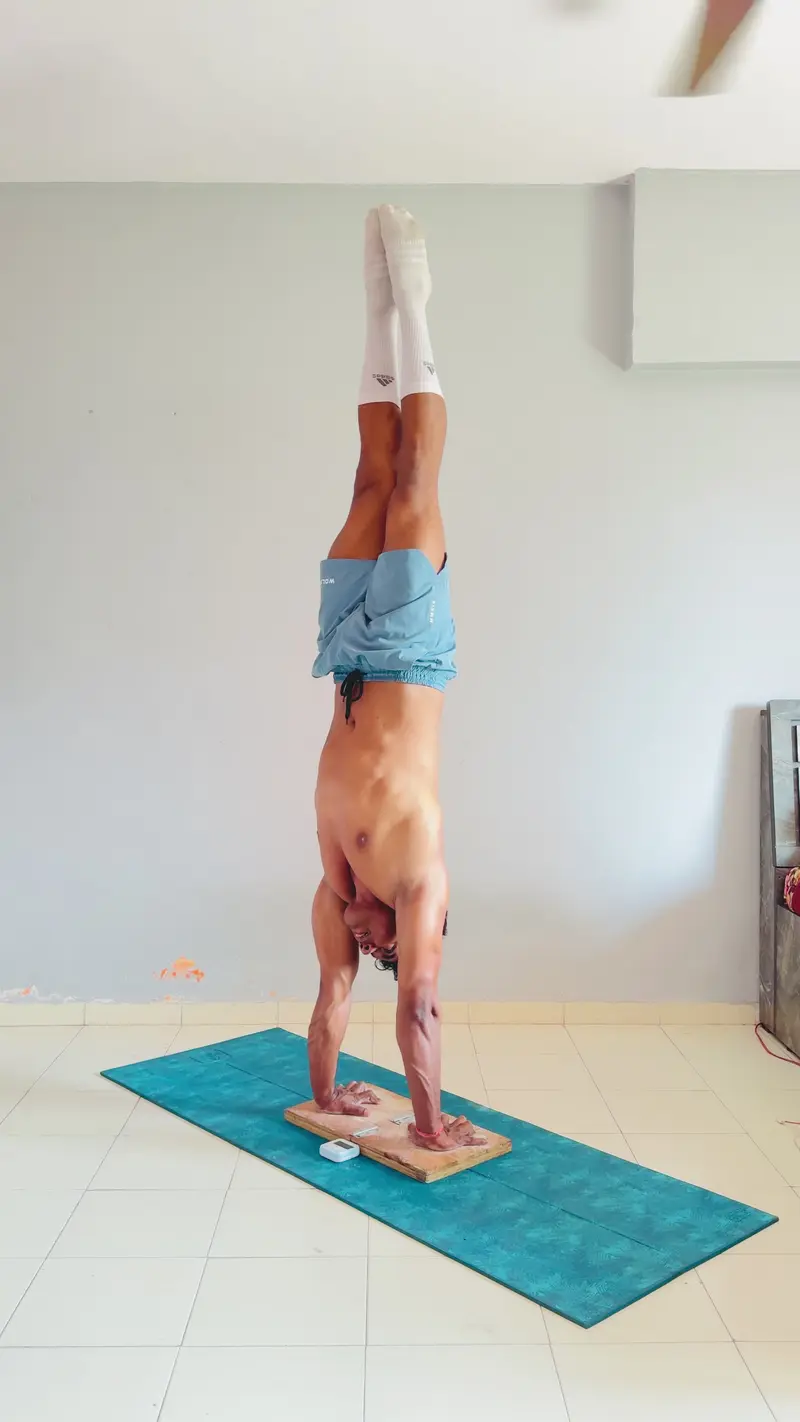
Handstand training asks the upper body to become the base of support.
The wrists contact the floor. The elbows transfer load. The shoulders support and organize the body overhead. If one of those areas is painful or unprepared, chasing the final skill can hide the more important question: is the foundation ready for this work?
Manoj's philosophy puts health and joint capacity before spectacle.
A handstand is a load, not only a shape
From the outside, a handstand may look like balance and alignment. Physically, it also asks the body to tolerate pressure in an unfamiliar orientation.
Preparation may include gradually developing:
- Comfort bearing weight through the hands.
- Wrist range appropriate to the chosen setup.
- Stable elbow organization.
- Active shoulder support overhead.
- Strength through the trunk and body line.
- Familiar, controlled ways to exit.
The right starting point varies. A student who has years of strength training is not the same as somebody who has never done a push-up.
Foundations are not a punishment
Being asked to step back can feel frustrating, especially if you have already attempted freestanding handstands.
But a regression is useful when it reveals a position you cannot yet control or a load you cannot yet tolerate. Wall work, scaled weight-bearing, mobility, and supporting strength may be the fastest route to a practice that lasts.
The purpose is not to keep the student at the beginning. It is to make the next progression more sustainable.
Do not hide pinching or pain
Manoj expects students to report an injury, impingement, pinching sensation, or pain.
That communication allows the session to change. A drill may need to be modified, a range reduced, or inverted work stopped. In some situations, the right next step is assessment by a doctor or physiotherapist rather than another training progression.
Pain is not a test of commitment.
Coaching and medical care have different roles
A coach can observe movement, adjust training stress, choose a more suitable progression, and recognize when an issue belongs outside the coaching scope.
A coach should not use a website article to diagnose the cause of your pain.
Manoj is particularly cautious about wrist, elbow and shoulder problems, injuries, medical conditions, and severe migraines that may make inversion inappropriate. Individual medical advice must come from an appropriately qualified professional.
Strengthen and lengthen
Manoj uses the phrase strengthen and lengthen to describe a broader goal.
Strength should not exist only in a narrow range. Mobility should not exist without control. Training can develop usable range and the ability to produce or resist force within it.
For handstands, that may mean combining:
- Progressive supporting strength.
- Controlled overhead mobility.
- Active rather than purely passive range.
- Position-specific preparation.
- Enough recovery between loading sessions.
The exact exercises depend on the assessment.
Robust joints are built progressively
Joint health is not created by one warm-up exercise. It is supported by appropriate load applied consistently over time.
Too little exposure may not build the required capacity. Too much, too soon, may exceed it. Individualized programming tries to find a workable progression between those extremes.
That is one reason Manoj asks about your training history, current strength, prior attempts, and what you feel during the movement.
Longevity changes the definition of progress
If the only measure of success is today's longest hold, it becomes easy to ignore warning signs.
A more complete view asks:
- Can you return to practice consistently?
- Is your position becoming more controlled?
- Are you building the physical qualities the skill requires?
- Can you communicate and respond when something does not feel right?
- Is the training supporting your health as well as your ambition?
The goal is not simply to get upside down once. It is to build a body and practice that can continue learning.
If you have current pain, injury, severe migraines, or a medical concern, seek appropriate professional guidance before beginning inverted training. For coaching questions, tell Manoj your history and current level honestly on WhatsApp.