
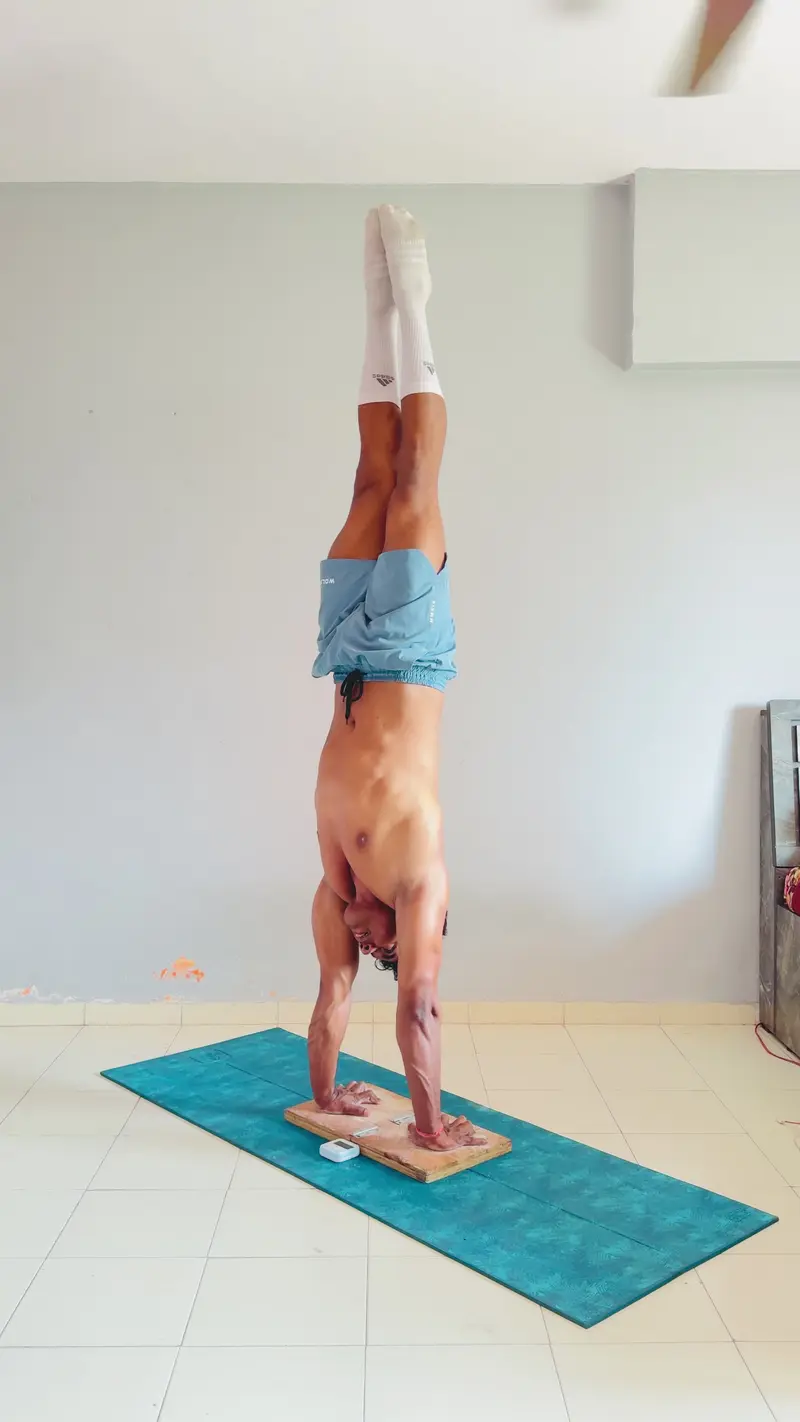
“Today’s work.”
That phrase appears repeatedly in Manoj’s content. It is simple, but it captures an important idea: a handstand is not built in one session.
Balance improves through exposure. The hands become more familiar with pressure. The shoulders learn the position. The kick becomes less mysterious. The student begins to recognise the difference between drifting toward the fingers and falling back toward the heels.
Those changes are difficult to force and easy to miss. Consistent practice makes them easier to notice.
Consistency is not the same as doing the maximum
It is tempting to define consistency as training hard every day. That is not a useful universal rule.
Practice frequency and volume depend on the person, their current capacity, the rest of their training, and how they recover. A session that repeatedly turns into fatigue and collapsing positions may create less learning than a shorter, more focused practice.
The better definition is: return to the skill regularly enough that each session can build on the last.
Give each session a purpose
Not every practice needs to solve everything.
One session might focus on entries. Another might spend more time at the wall. Another might work on straightening the line or exploring a tuck. Advanced athletes may separate strength work, handstand endurance, shapes, and pressing skills.
A useful session can be organised around one question:
- What am I trying to feel?
- What am I trying to repeat?
- What changed from the previous attempt?
- What should remain the same?
This keeps practice from becoming an endless sequence of kicks.
Progress is often visible in hindsight
The first signs of improvement may not be a ten-second hold.
They may look like:
- Less fear before the entry.
- More consistent hand placement.
- A quieter touch at the wall.
- Better recognition of an over-kick.
- More control while coming down.
- The ability to repeat a shape that previously happened by accident.
Video can help because it gives the student something more objective than memory. It also gives a coach material to compare and respond to.
Keep the practice connected to strength
Manoj’s content rarely separates handstands from the broader physical work. “Skills and strength” appear together because consistent skill practice needs a body that can continue supporting the position.
Some days may therefore look less like balancing and more like building capacity. That does not mean the handstand has been forgotten. It means the base is being trained.
Avoid turning every session into a verdict
A difficult day does not erase previous progress. A strong day does not finish the journey.
Handstands are sensitive to attention, fatigue, confidence, and small technical changes. Treating each session as a final judgment creates unnecessary pressure.
“Today’s work” is a more productive frame. Do the useful work available today. Learn what you can. Return with that information.
If you want help deciding what your own practice should emphasise, tell Manoj your current level on WhatsApp. His newest daily work remains on @handstand_with_manoj.